
How do RFID badges make waste container management easier?
The RFID badge is a central part of modern waste management systems, especially for pay-as-you-throw charging. It identifies users precisely and controls access to collection equipment such as containers and drop-off banks. For local authorities that want to improve sorting and control costs, the badge is a reliable, easy-to-deploy and durable solution.
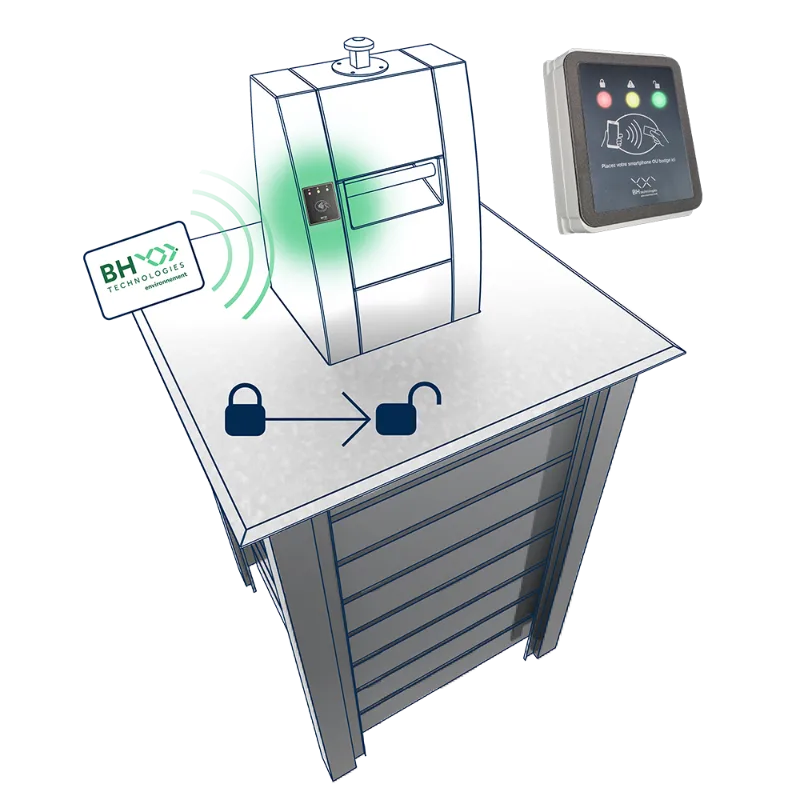
What is an RFID badge for waste containers?
It is a contactless identification device. Each badge is linked to a user or a household, so the person is recognised automatically when they use a collection point. Unlike traditional systems, RFID needs no physical contact or manual input. Use is quick and smooth, which is essential for residents to accept it.
How the badge works
The badge exchanges information with a reader installed on the container. When the user presents the badge, the system checks their access rights; if they are valid, the container opens automatically. Each use can be recorded in a database, so the local authority can track deposits, analyse behaviour and optimise waste management. This traceability is essential for pay-as-you-throw charging.
RFID badges and pay-as-you-throw
User identification and fairness
With an RFID badge, each deposit is linked to a specific user. Billing is fair because it is based on the waste actually produced. Without this kind of system, fairness cannot be guaranteed, especially in apartment buildings. Identification also makes users accountable and encourages them to reduce their waste and sort better.
Data to manage the service
The badge collects valuable data from each container, which helps the local authority adjust its strategy and continuously improve its service.
Benefits of RFID access control
Complete, reliable traceability
Since every action is recorded, the local authority knows exactly who drops off what, when and where. This makes management, monitoring and transparency towards residents easier.
Protection against misuse
Badge-controlled containers greatly limit fraud and unauthorised use. Only registered users can access the equipment.
Changes in user behaviour
Being identified has a direct effect on behaviour: users pay more attention to sorting and to the amount of waste they produce. In a rural community of municipalities in Brittany equipped with 141 access-controlled containers, residual household waste fell by 61% (case study, in French).
A solution for residents and visitors
Beyond physical badges, mobile apps can replace the badge entirely, with contactless opening via Bluetooth, quick account activation and access-rights management. They also offer container location, deposit history and built-in payment. Visitors and tourists can get one-off access without a badge or prior registration, paying directly by bank card. This flexibility improves the user experience and reduces illegal dumping.
An example of an RFID solution for waste
Redin, BH Environnement’s container access control, natively offers several access options for residents and visitors: badge, QR code or the Ecopass mobile app (virtual badge and tokens).
The RFID badge has become an essential technology for local authorities that want effective pay-as-you-throw charging. By combining identification, traceability and ease of use, it is a powerful lever to improve waste management. See also our guide to choosing waste container access control.

About the author
CEO of BH Environnement
Jeroen Bos has led BH Environnement since 2025. He joined the BH group in 2018, first in technical support and then in business development, before taking over the Environment business line of BH Technologies in 2021. He supports local authorities with container access control and pay-as-you-throw projects, from scoping to roll-out. Before BH, he founded and ran two companies in the Netherlands and Belgium.
Would you like a free demo?
We will be happy to give you a free demonstration of our solution and discuss your project.