
How does waste collection route optimisation cut the carbon footprint of local authorities?
Decarbonising local public services is no longer a theoretical goal. Regulations and citizens’ expectations have made it part of the daily work of local authorities, and waste collection is one of the most immediate levers. Every collection round means kilometres, fuel and CO2 emissions. Optimising routes is therefore not only a matter of organisation: it is a direct, measurable and fast way to reduce environmental impact.
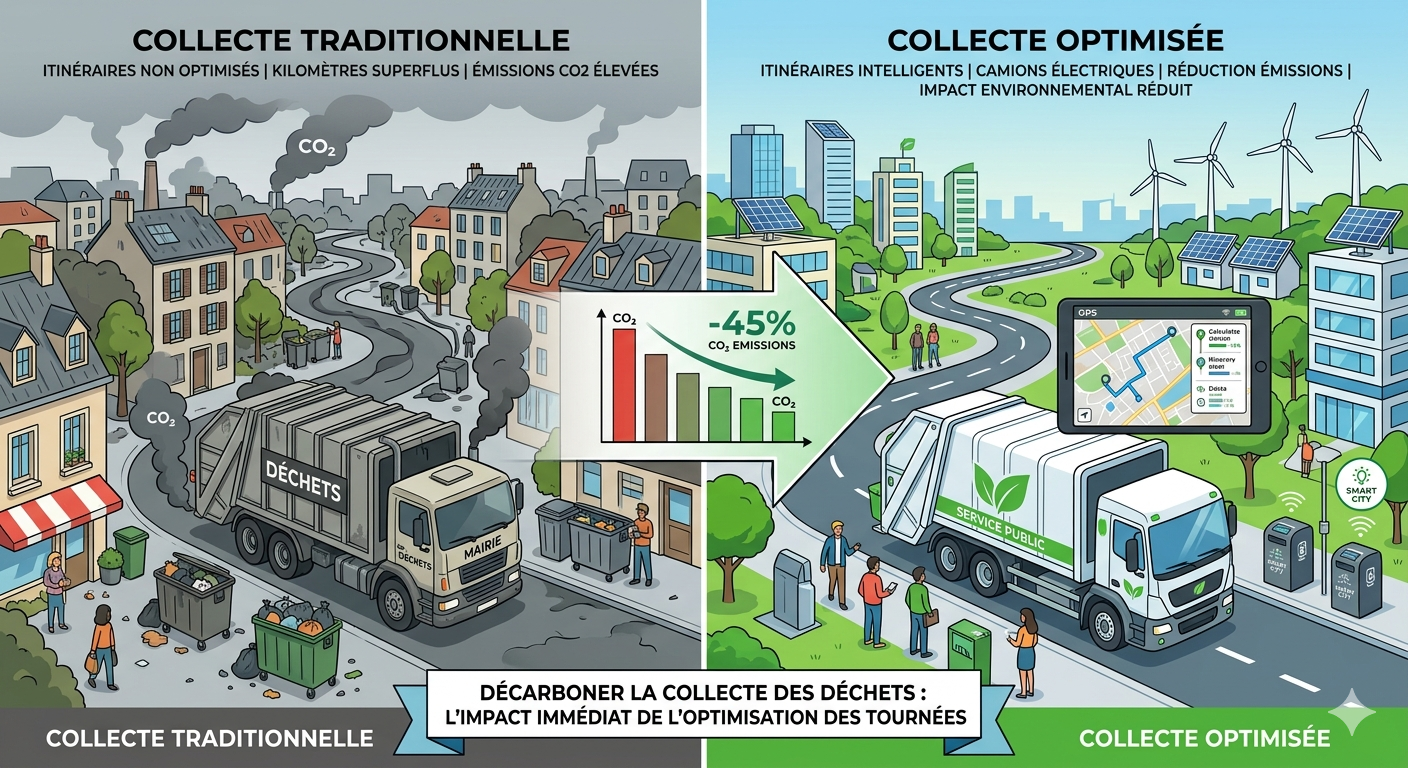
The carbon footprint of urban waste collection
High fuel consumption in urban driving
A refuse truck uses a lot of fuel in town, because of stop-and-go traffic, and every litre of diesel burned emits CO2 (official French emission factors are published by ADEME in its Base Empreinte). Over a year and across a whole fleet, the impact is considerable.
Frequent stops increase emissions
Collection involves constant stops, and every restart puts heavy load on the engine. As a result, fuel consumption rises, CO2 emissions increase, and fine particles and NOx multiply. Collection becomes a direct source of local pollution.
Greater pressure in dense urban areas
In city centres, heavy traffic, poor traffic flow and a large number of collection points concentrate emissions in areas that are already sensitive.
The limits of traditional collection rounds
The historical model relies on fixed routes, and this approach quickly shows its limits.
Collections disconnected from actual fill levels
In a conventional system, some containers are emptied half-full, others overflow before the truck arrives, and rounds stay the same whatever the variations. In other words, the service works blind.
Structural operational inefficiency
This lack of adaptation leads to unnecessary kilometres, excess fuel consumption and over-mobilised crews. Costs rise without any improvement in service.
Route optimisation: a concrete and effective answer
Optimisation follows a simple logic: collect at the right time, in the right place.
Collection triggered by actual need
Rounds are adjusted to the fill level of each container, measured by fill-level sensors. Trucks only travel when needed, routes are recalculated continuously and priorities are ranked.
Results measured in the field
At Pays de Montbéliard Agglomération, a conurbation of more than 100,000 inhabitants in eastern France, 1,100 laser sensors were installed on drop-off containers. On glass collection, the local authority measured 24% less fuel (from 1,120 to 850 litres per month), 31% lower collection costs and 35% more tonnes collected per 100 km driven (case study, in French).
Better use of resources
Trucks drive less, and above all drive better: every stop is useful. Fuel is better used, crews are more efficient and the service is more consistent.
Lower CO2 emissions: measurable results
Gains visible in the first months
Unlike other environmental levers, the benefits are immediate: fewer kilometres driven, lower fuel consumption and lower CO2 emissions.
An impact across the whole territory
Across a fleet of several trucks, the savings add up: tonnes of CO2 avoided each year, less noise and better air quality. The impact goes well beyond logistics.
A strategic lever for environmental policy
Feeding climate plan indicators
Route data makes it possible to track avoided emissions, fuel savings and performance over time. These indicators feed directly into local climate plans (such as the French PCAET) and CSR reports.
Showing the results to citizens
Communicating concrete results builds trust, highlights local initiatives and demonstrates tangible commitments.
Compatible with new powertrains
The range of electric trucks
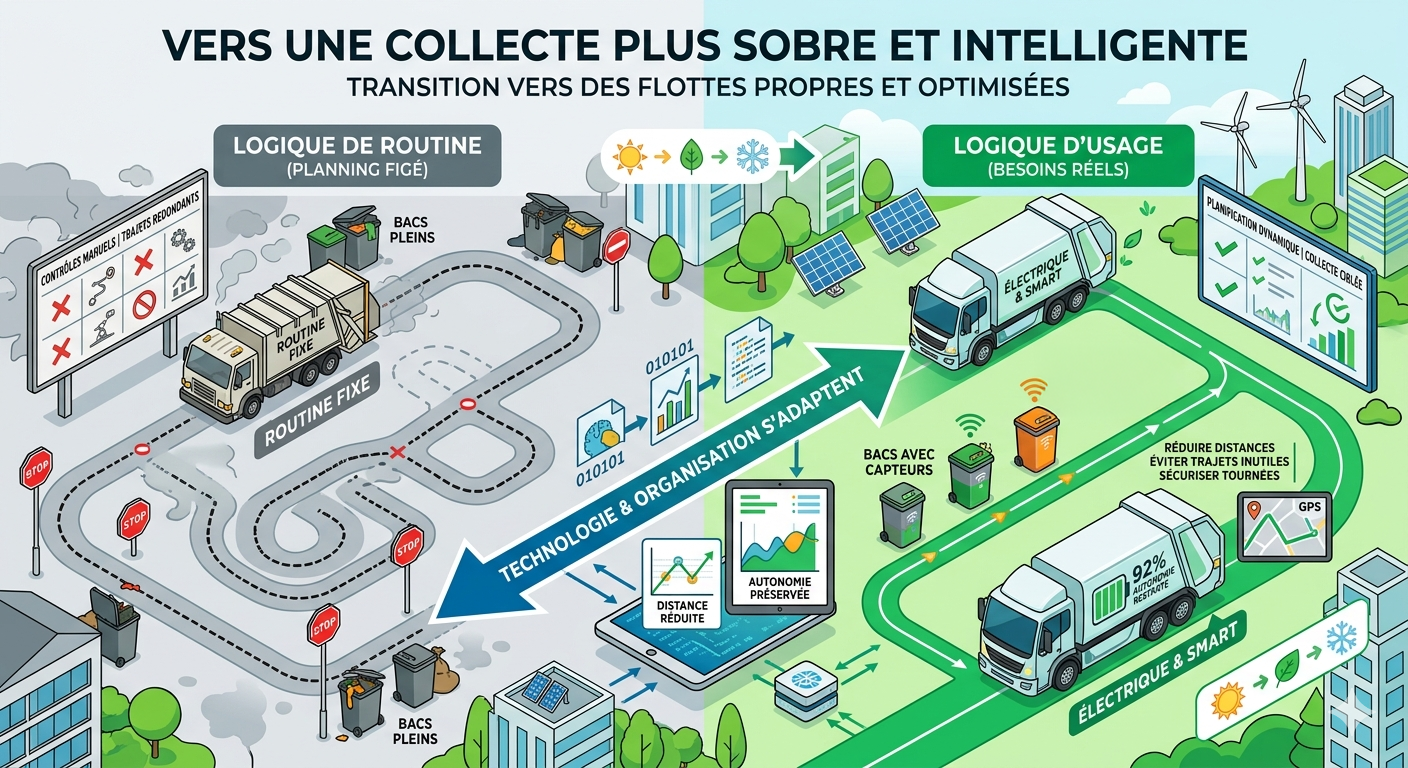
Electric refuse trucks have a limited range, so every kilometre counts. Optimisation shortens distances, avoids unnecessary trips and makes rounds more secure.
Organisation and technology go together
Performance does not depend on the vehicle alone. It also depends on planning, route optimisation and the use of data.
Towards leaner and smarter collection
From routine to actual use
Collection no longer follows a fixed schedule but actual needs. This improves efficiency, environmental impact and service quality.
A sustainable approach that evolves
This organisation adapts over time to seasonal variations, changes in the territory and new uses. Collection becomes more resilient.
FAQ: waste collection route optimisation
What are the quickest gains?
The reduction in kilometres driven is immediate and directly lowers emissions.
Does optimisation work everywhere?
Yes, in urban and rural areas alike.
Does existing equipment need to be replaced?
No. Optimisation relies first on organisation and on the use of data.
How can performance be tracked?
With simple indicators: distances, fuel consumption and avoided emissions.

About the author
Deputy CEO of the BH group, founder of Heyliot
Cyril Pradel founded Heyliot (now BH Environnement) in 2017 and ran it for eight years. He led the design and French manufacturing of the Heywaste fill-level sensors and filed a patent on laser measurement of container fill levels. With more than twenty years in information systems, networks and IoT, he is now Deputy CEO of the BH group (BH Technologies and BH Environnement), in charge of digital transformation and AI.
Would you like a free demo?
We will be happy to give you a free demonstration of our solution and discuss your project.