
Waste sensor connectivity: LoRaWAN, Sigfox, LTE-M and NB-IoT compared
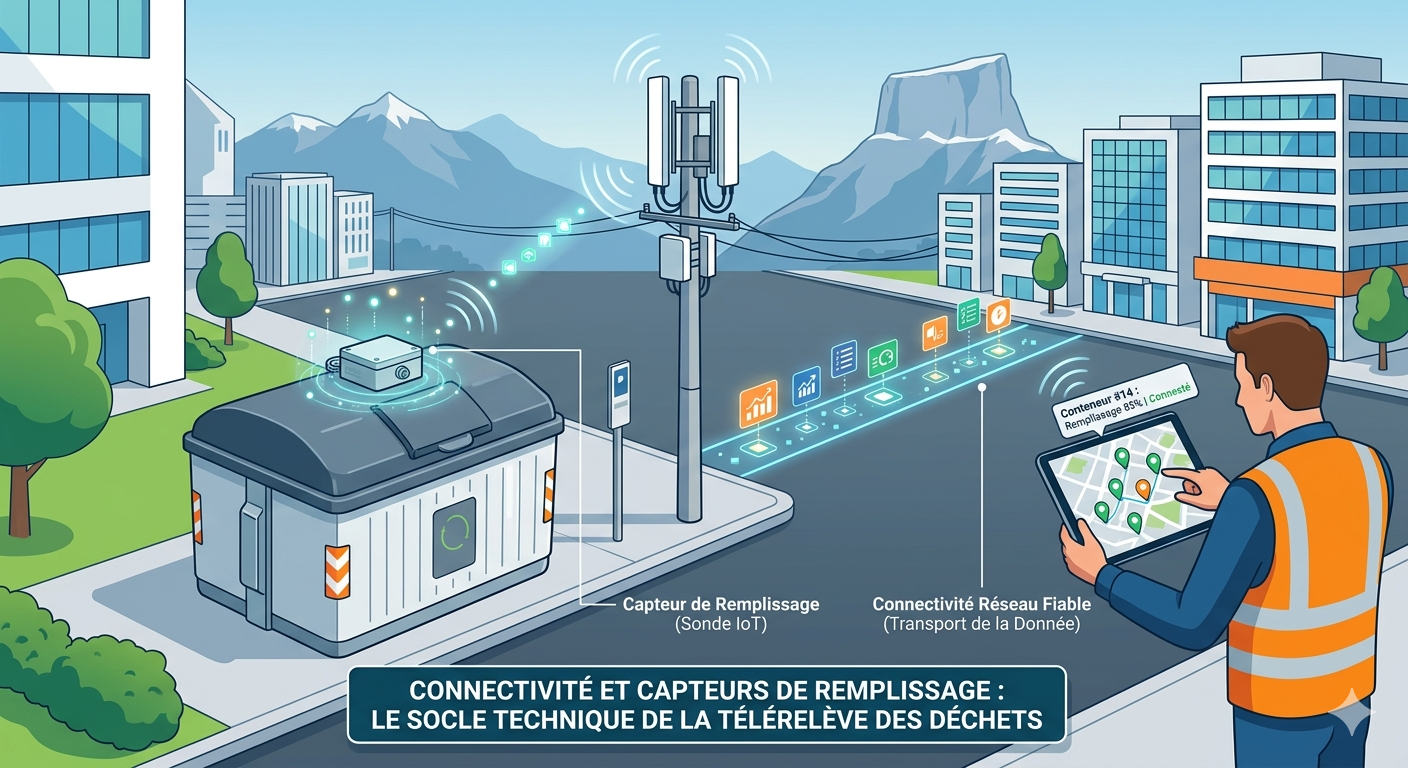
Installing a fill-level sensor in a waste container is one thing. Making sure its data comes back reliably, every day, is another. The performance of a smart waste system depends as much on the network that carries the data as on the sensor itself. Without the right connectivity, even the best sensor goes silent.
Measuring the fill level: the role of the sensor
Before talking about transmission, you need to look at how the data is produced.
Ultrasound, laser or radar: three measurement technologies
Fill-level sensors used in containers and drop-off banks rely on three technologies: ultrasound, historically the most common, time-of-flight (ToF) laser and radar. The principle is the same. The sensor sends a signal (sound wave, laser beam or radio wave) towards the waste. The signal bounces back to the sensor, and the return time gives the distance to the waste, and therefore the fill level. No contact with the waste is needed, which limits wear and keeps the measurement stable over time.
Accuracy suited to field conditions
Inside a waste container, volume changes, liquids and irregular waste can disturb the measurement. Ultrasonic sensors offer centimetre-level accuracy. A time-of-flight laser goes further: the Heywaste Compact sensor measures to ±1 mm at 1 metre and ±30 mm at 4 metres. For dirty streams (glass, household waste), radar is designed to stay reliable despite dirt: it is the technology used by the Heywaste Radar sensor.
Connectivity: getting the data through
Once measured, the data has to be transmitted, and this is where things get harder.
Tough technical constraints
Unlike many IoT uses, waste sensors sit in difficult places: metal containers, underground installations, or areas poorly covered by conventional networks. The chosen technology must get through obstacles, run on very little power and deliver the data reliably.
IoT networks suited to waste monitoring
LoRaWAN: battery life and control
LoRaWAN has become a reference for local authorities. This long-range technology sends data over several kilometres while using very little energy. It can also run on a private network, giving full control over the infrastructure and long-term costs. Its ability to reach into buildings and underground structures makes it well suited to waste management.
NB-IoT: performance and operator coverage
NB-IoT runs on existing mobile operator networks. It benefits from wide coverage and a high quality of service, with very good penetration indoors and underground. It does involve operator subscriptions.
LTE-M and Sigfox
LTE-M, also run by mobile operators, offers higher data rates and two-way communication, including remote updates, at the cost of higher power use. Sigfox is an operated low-power network for very short messages.
The table below sums up the differences between the four networks used by fill-level sensors. Battery life figures come from the Heywaste Laser and Heywaste Radar datasheets; they vary with the number of measurements and transmissions per day.
| Network | Type | Range and penetration | Data rate and two-way traffic | Power use | Heywaste Laser / Radar battery life |
|---|---|---|---|---|---|
| LoRaWAN | Low-power network on licence-free frequencies (868 MHz), public (operator) or private (the authority’s own gateways) | Several kilometres, good penetration into underground containers | Low data rate, a few messages per day | Very low | 10 years |
| Sigfox | Operated low-power network, licence-free frequencies (868 MHz) | Long range, operator’s national coverage | Very low data rate (short messages), little downlink traffic | Very low | Not available (Sigfox: Heywaste Compact only) |
| LTE-M | Mobile operators’ cellular network (low-power 4G, licensed bands) | National mobile coverage, good penetration | Higher data rate, two-way traffic, remote updates | Higher than LoRaWAN | 5 years |
| NB-IoT | Mobile operators’ cellular network (licensed bands) | Very good penetration indoors and underground | Low data rate, two-way traffic | Low | 7 years |
Choosing the right network for your territory
The choice depends on several factors. A dense area with many sensors may favour a network it controls, such as a private LoRaWAN network. A larger, more spread-out area may rely on existing operator infrastructure. Either way, the goal is the same: reliable, continuous and usable data.
Battery life and durability: deciding criteria
A sensor is not meant to be handled often. It must run for several years without intervention.
Long-term battery life
Battery life depends directly on the sensor’s power use, the network and how often it transmits. Heywaste Laser and Radar last 5 years on LTE-M, 7 years on NB-IoT and 10 years on LoRaWAN; Heywaste Compact lasts more than 5 years with 24 measurements and 6 LoRaWAN transmissions per day.
Finding the right transmission rate
Sending data continuously may seem ideal, but it drains the battery. Transmissions that are too far apart limit responsiveness. In practice, regular measurements combined with a few transmissions per day are enough to plan collection rounds effectively.
Ruggedness and reliability
A waste sensor faces extreme conditions, so it must be particularly rugged.
Protection ratings
Protection ratings such as IP (water and dust tightness) and IK (impact resistance) are not technical details. With high-pressure washing and heavy waste falling into containers, they are essential. Heywaste Compact is rated IP69K and IK10.
Resistance to corrosive environments
Decomposing waste releases gases that can be corrosive and damage equipment. Sensors must withstand these conditions over the long term without losing performance.
FAQ: waste sensor connectivity
Which technology should a local authority choose?
LoRaWAN is often preferred for its flexibility and very low power use. NB-IoT and LTE-M are good options where operator coverage is strong.
Do sensors work underground?
Yes, as long as the network used can reach into underground structures, as LoRaWAN and NB-IoT can.
How long does a sensor last?
Typically 5 to 10 years, depending on the network and the number of transmissions per day.

About the author
Deputy CEO of the BH group, founder of Heyliot
Cyril Pradel founded Heyliot (now BH Environnement) in 2017 and ran it for eight years. He led the design and French manufacturing of the Heywaste fill-level sensors and filed a patent on laser measurement of container fill levels. With more than twenty years in information systems, networks and IoT, he is now Deputy CEO of the BH group (BH Technologies and BH Environnement), in charge of digital transformation and AI.
Would you like a free demo?
We will be happy to give you a free demonstration of our solution and discuss your project.