
How do fill-level sensors transform the ROI of waste collection?
With local authority budgets under pressure, waste management is one of their biggest expense items. Optimising collection costs and calculating the return on investment is no longer optional: it is a strategic necessity. Fill-level sensors for waste containers radically change the economics of collection.
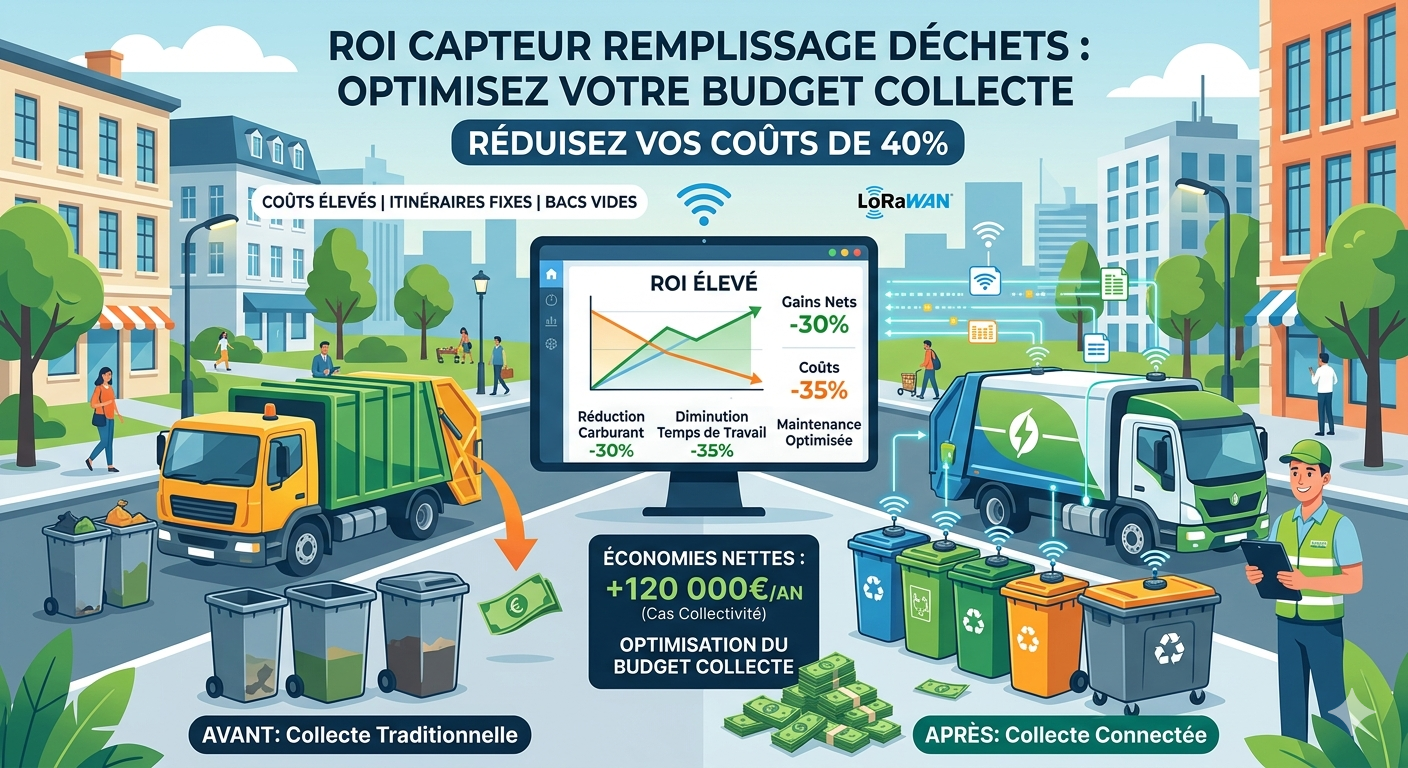
Cost analysis: why fixed-schedule collection is outdated
Fixed-route collection rests on a costly assumption: every bin must be emptied at a set frequency, whether it is full or empty.
-
The cost of emptiness: on fixed routes, a large share of containers is emptied while far from full. At Pays de Montbéliard Agglomération, glass banks were only 48% full on average at collection time before sensors were installed (case study, in French).
-
Mechanical wear: a 26-tonne collection truck wears out faster (brakes, tyres, engine) with every unnecessary stop.
-
Staff costs: the time crews spend checking half-empty bins is a wasted resource that could go to preventive maintenance.
Calculating the ROI of a fill-level sensor deployment: method and measured results
ROI is calculated by dividing the net gain from operational savings by the total cost of ownership (hardware, subscription and installation). Gains depend on the number of containers, the waste streams and the starting organisation. They come from three areas:
-
Lower fuel bills: fewer unnecessary trips, so fewer kilometres and less fuel.
-
Less collection time: shorter rounds free up crew time, for example to cut overtime.
-
Lower maintenance costs: fewer kilometres and stops mean less wear on brakes, tyres and engines.
Real case: 31% lower costs on glass collection
At Pays de Montbéliard Agglomération (Doubs, eastern France, more than 100,000 inhabitants), 1,100 laser sensors were installed on drop-off containers and park bins. On glass collection, the authority measured 24% less fuel (from 1,120 to 850 litres per month), 31% lower collection costs and 35% more tonnes collected per 100 km driven. The average fill rate at collection rose from 48% to 63% (read the case study, in French). To estimate the ROI of your own project, apply these orders of magnitude to your current collection costs, then compare them with the cost of the sensors and the subscription, published on our pricing page.
Frequently asked questions
Q: What is the hidden cost of a fill-level sensor?
A: The main hidden cost is connectivity. However, with networks such as LoRaWAN, subscriptions remain modest compared with the savings: our prices are public, from €1.90 to €5 per sensor per month depending on the plan (see the pricing page).

About the author
Deputy CEO of the BH group, founder of Heyliot
Cyril Pradel founded Heyliot (now BH Environnement) in 2017 and ran it for eight years. He led the design and French manufacturing of the Heywaste fill-level sensors and filed a patent on laser measurement of container fill levels. With more than twenty years in information systems, networks and IoT, he is now Deputy CEO of the BH group (BH Technologies and BH Environnement), in charge of digital transformation and AI.
Would you like a free demo?
We will be happy to give you a free demonstration of our solution and discuss your project.